Description
A made to order Bimetal bandsaw blade
Material: Bimetal
Length: 1140 mm
Width: 12.7 mm
TPI: 10/14 TPI
Not quite right?
Order a custom size Bandsaw Blade
Bimetal bandsaw blades represent a significant advancement in cutting technology, offering unparalleled performance and durability in comparison to traditional carbon blades. Made from two distinct materials expertly fused together, bimetal blades revolutionise cutting applications across various industries.
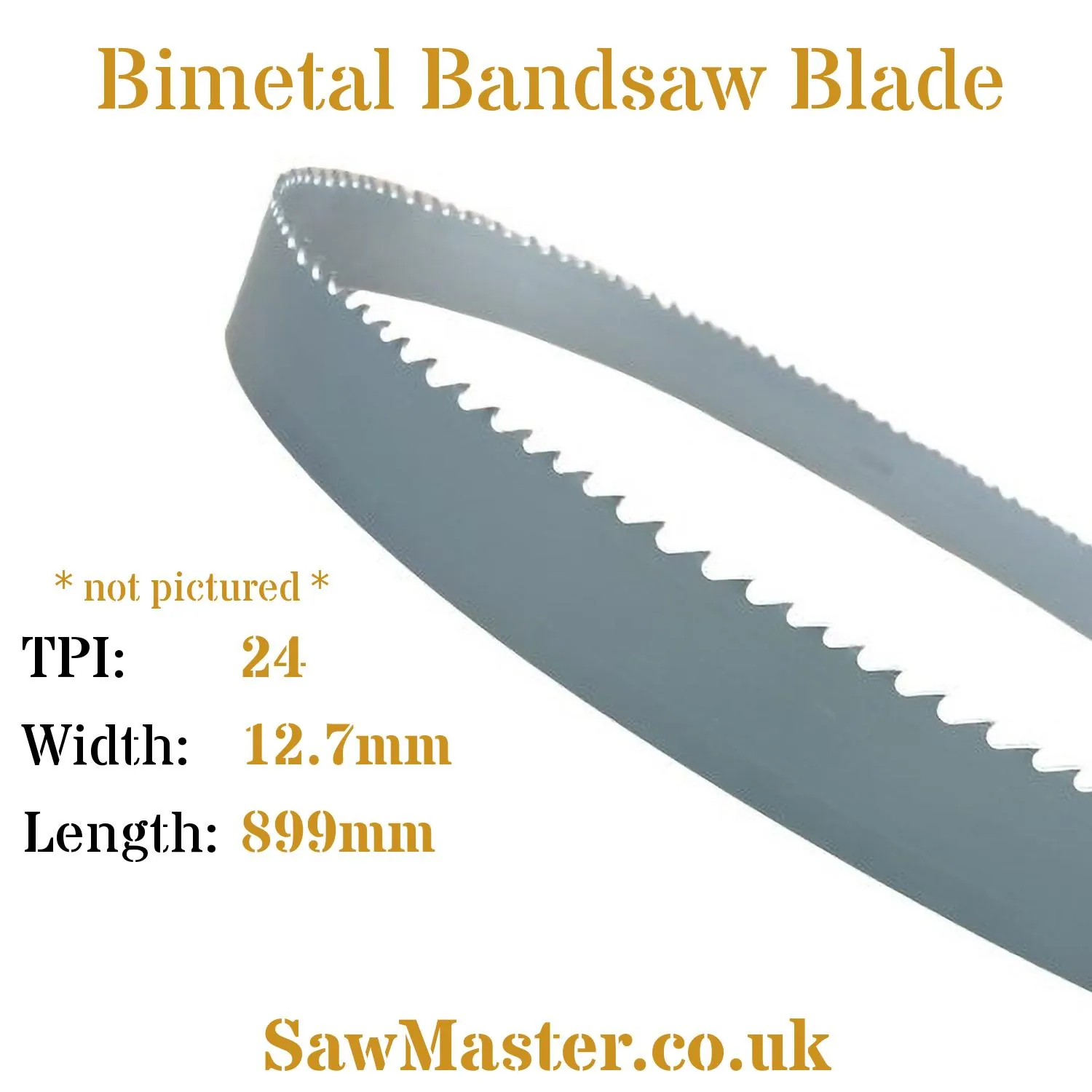
About this 898mm 12.7mm 24 TPI bimetal blade
This is a bimetal bandsaw blade, 898mm long and 12.7mm (1/2″) wide, with 24 teeth per inch. The HSS tooth edge is welded to a flexible spring steel back, giving a blade that stays sharp in metal while the short band flexes tightly around small wheels.
24 TPI is a very fine pitch, with teeth only about 1mm apart. It is meant for thin metal: sheet, thin-wall tube and box section, conduit, light angle and small solid bar in steel, stainless steel, aluminium, brass and copper. Around 3mm of material under the blade keeps three teeth in contact, so very thin sheet is best sandwiched or clamped to a backing piece. On thicker solid bar a coarser pitch will cut faster and cooler.
An 898mm length is short, typical of compact and portable metal-cutting bandsaws, so confirm the exact length your saw takes. At 12.7mm wide the band is stiff enough to cut straight and square through small sections.
Run a new blade in gently and use cutting fluid where your saw allows to make the most of the HSS edge.
How to check this is the right blade
Check the length printed on your machine plate or on the old blade, and confirm it is 898mm. Measure the width across the band from the tooth tips to the back edge: it should be 12.7mm. Then count the teeth over 25mm (one inch) and you should find 24. Our guides how are bandsaw blades measured and which TPI do I need explain each check step by step.
Why is 24 TPI recommended for thin tube?
Thin walls only give a few millimetres of contact. A fine pitch keeps enough teeth on the work so none are overloaded, which prevents snagging and stripped teeth.
Can I use this blade on wood?
It will cut, but the tiny gullets clog quickly in timber. For wood a coarser blade is far better, and a carbon blade is a cheaper option for wood-only work.
Reviews
There are no reviews yet.